Cricket has undergone several transformations throughout its long history, but perhaps none has been as dramatic as the introduction of Twenty20 cricket, commonly known as T20.
This fast-paced format has brought a new level of excitement, entertainment, and global popularity to the sport.
The Birth of T20 Cricket
The concept of T20 cricket was first introduced in England in 2003 by the England and Wales Cricket Board. The idea was to create a shorter and more entertaining version of cricket that could attract younger audiences and fit into modern lifestyles.
Unlike Test matches that last five days or ODIs that take an entire day, a T20 match can be completed in about three hours, making it perfect for television broadcasting and stadium entertainment.
Basic Rules of T20 Cricket
In T20 cricket, each team is allowed to play 20 overs, which means the entire match is limited to 40 overs.
This format encourages aggressive batting, innovative bowling strategies, and spectacular fielding.
Players often take more risks, resulting in big sixes, fast scoring rates, and thrilling finishes.
The First T20 International Match
The first official T20 International match was played in 2005 between Australia national cricket team and New Zealand national cricket team.
Although it was initially seen as a fun experiment, the match proved extremely popular among fans.
Soon after, cricket boards around the world started organizing T20 tournaments.
The First T20 World Cup
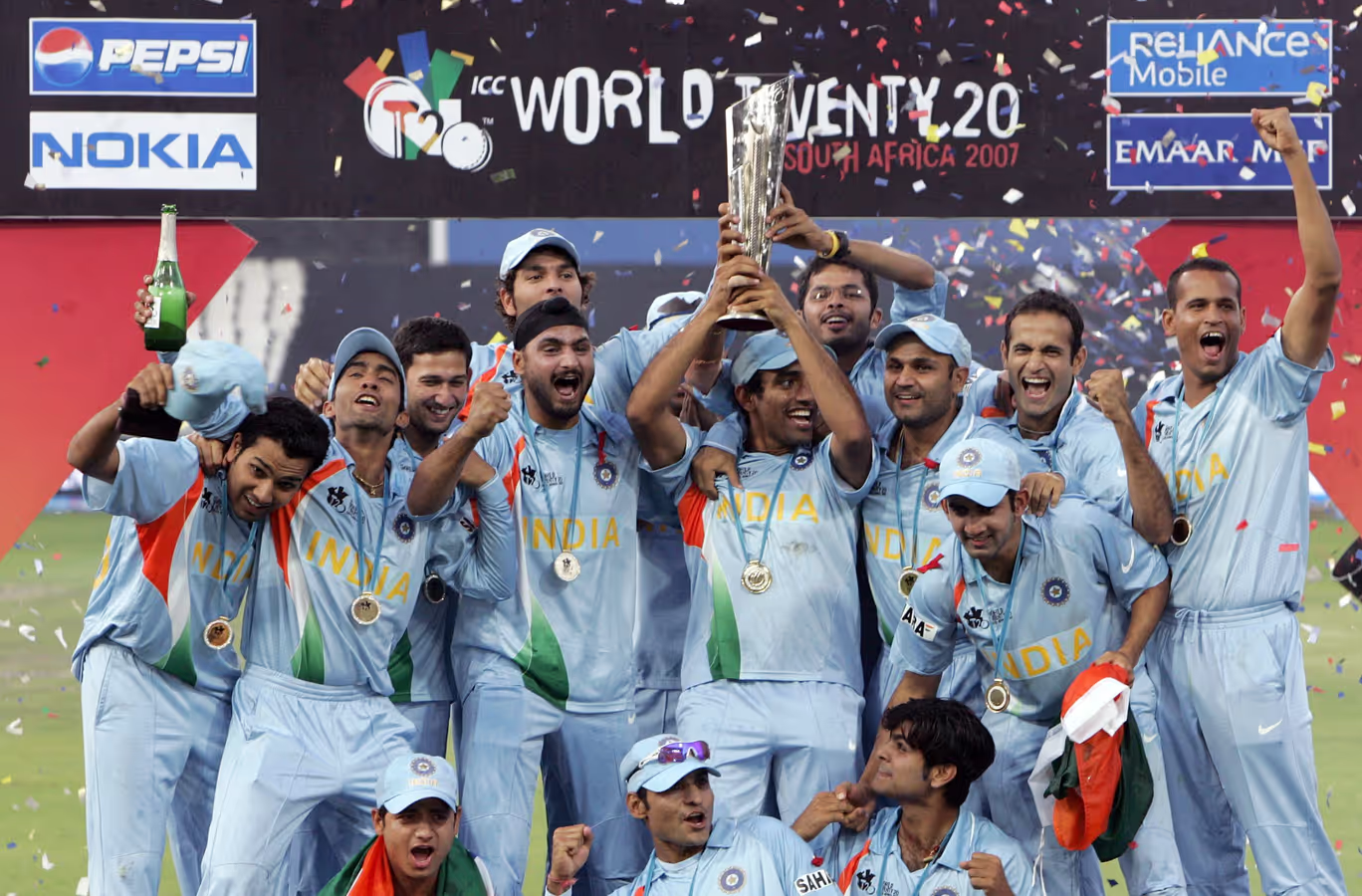
The real turning point for T20 cricket came in 2007, when the ICC organized the first T20 World Cup in South Africa.
The tournament was a massive success and featured many unforgettable matches, including the dramatic final between India and Pakistan.
India eventually won the tournament under the leadership of MS Dhoni, and the victory sparked a huge wave of enthusiasm for T20 cricket in the country.
Rise of Franchise T20 Leagues
Following the success of the T20 World Cup, franchise-based leagues began emerging across the world.
The most successful of these is the Indian Premier League, launched in 2008.
The IPL revolutionized cricket by bringing together international stars, young domestic players, massive sponsorship deals, and global broadcasting.
Other leagues such as the Big Bash League, Caribbean Premier League, and Pakistan Super League followed similar models.
Impact on Modern Cricket
T20 cricket has significantly influenced how the game is played today.
Batsmen have developed innovative shots like the scoop and reverse sweep, while bowlers have introduced variations such as slower balls and yorkers.
Fielding standards have also improved dramatically because every run saved can make a difference in such a short format.
Criticism of T20 Cricket
Despite its popularity, T20 cricket has also faced criticism from traditional cricket fans.
Some critics argue that the format prioritizes entertainment over technique and could overshadow longer formats like Test cricket.
However, many experts believe that T20 cricket has helped attract new audiences and expand the global reach of the sport.
The Future of T20 Cricket
Today, T20 cricket is one of the most commercially successful formats in the world.
It has opened opportunities for players from emerging cricket nations and created new platforms for young talent to showcase their skills.
With new leagues, growing fan engagement, and technological advancements, T20 cricket is expected to remain a major part of the sport’s future.
Conclusion
T20 cricket has transformed the way the game is played and consumed. Its fast pace, thrilling moments, and entertainment value have brought millions of new fans to the sport.
While traditional formats continue to hold their importance, T20 cricket has undeniably revolutionized cricket and ensured its popularity in the modern era.