The year 2007 marked a revolutionary moment in cricket history with the introduction of the first-ever ICC T20 World Cup. The tournament brought together the excitement of Twenty20 cricket with the prestige of an international championship, creating a competition that would forever change the landscape of the sport.
Organized by the International Cricket Council, the tournament was hosted in South Africa and featured some of the best teams in the world.
What started as an experimental format soon turned into one of the most thrilling tournaments cricket had ever seen.
Why the T20 World Cup Was Created
By the early 2000s, cricket administrators realized that the sport needed a faster and more entertaining format to attract younger audiences.
While Test cricket was rich in tradition and One Day Internationals had already gained popularity, the newly introduced Twenty20 format offered a much shorter and more exciting version of the game.
After the success of domestic T20 leagues in England, the ICC decided to launch a global tournament dedicated to the format.
The result was the first T20 World Cup in 2007.
Teams and Format
The inaugural tournament featured 12 teams, including major cricketing nations such as:
- India
- Pakistan
- Australia
- England
- South Africa
- New Zealand
- Sri Lanka
- West Indies
The teams were divided into groups, followed by a Super 8 stage, semifinals, and the final.
The tournament quickly produced several thrilling matches and unexpected results.
Early Highlights of the Tournament
One of the early shocks of the tournament was the elimination of the powerful Australian team before the knockout stages.
Meanwhile, teams like India and Pakistan gained momentum with strong performances.
A particularly memorable moment occurred when Yuvraj Singh hit six consecutive sixes in a single over against England’s Stuart Broad. This spectacular display of power hitting became one of the most iconic moments in T20 cricket history.
India vs Pakistan – The Group Stage Thriller
The rivalry between India national cricket team and Pakistan national cricket team added even more excitement to the tournament.
During their group-stage encounter, the match ended in a tie, which was decided by a unique bowl-out—a method similar to penalty shootouts in football.
India won the bowl-out, adding another unforgettable moment to the tournament.
The Semifinals
The semifinal matches featured four strong teams:
- India
- Pakistan
- Australia
- New Zealand
India defeated Australia in a thrilling match thanks to a brilliant innings by Yuvraj Singh.
Pakistan secured their place in the final by defeating New Zealand.
This set up a dream final between the two arch-rivals: India and Pakistan.
The Historic Final
The final was played at the iconic Wanderers Stadium in Johannesburg.
India, led by the young and relatively inexperienced captain MS Dhoni, batted first and posted a competitive total of 157 runs.
Pakistan fought hard during their chase and came very close to victory.
In the final over, Pakistan needed 13 runs to win. The tension was immense as millions of fans around the world watched the dramatic finish.
With just a few runs needed, Pakistan’s Misbah-ul-Haq attempted an innovative scoop shot but mistimed it. The ball was caught by Sreesanth, giving India a dramatic victory.
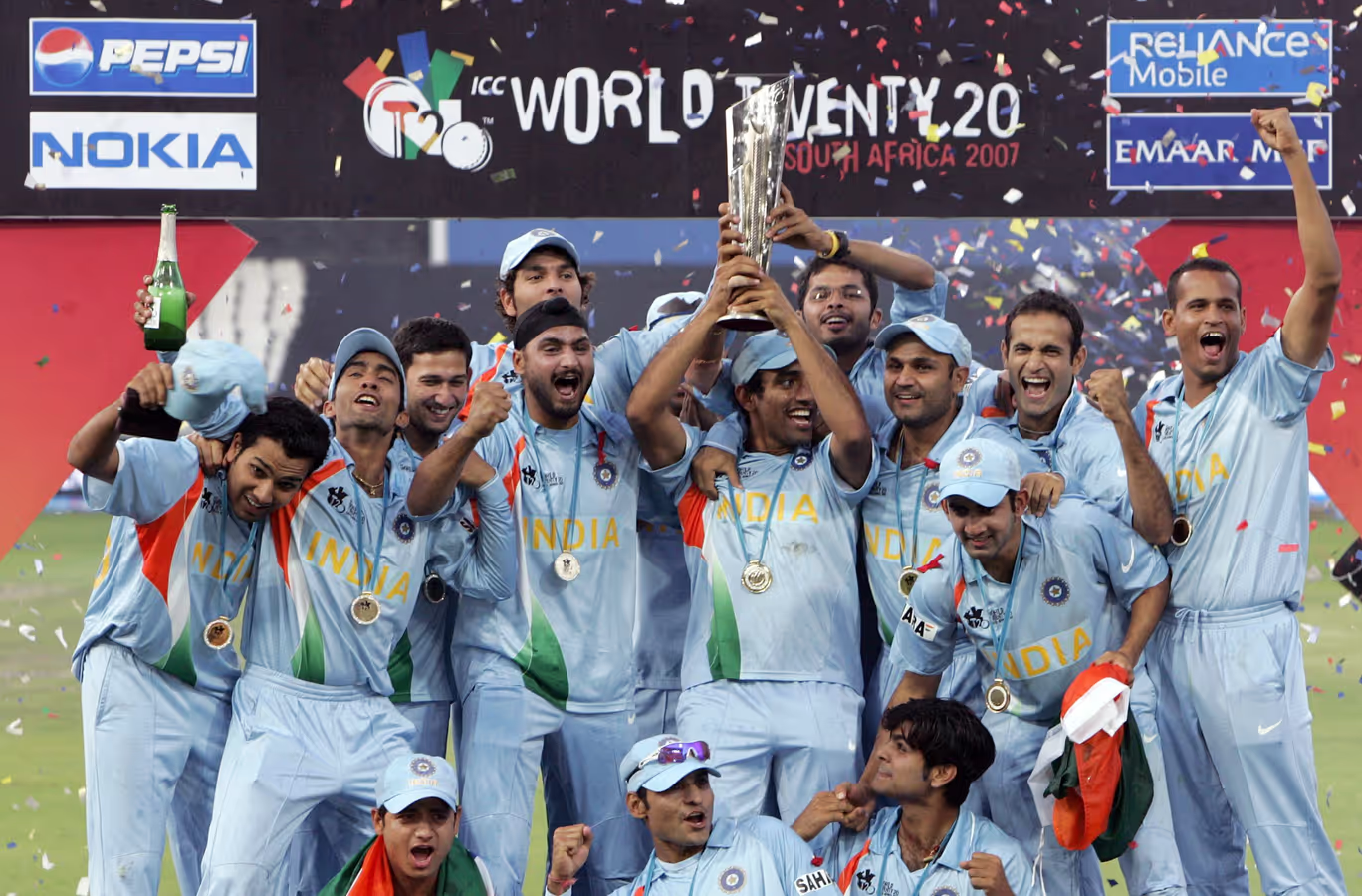
India won the match by 5 runs, becoming the first-ever T20 World Cup champions.
Impact on World Cricket
India’s victory in the 2007 T20 World Cup had a massive impact on the sport.
The tournament proved that T20 cricket could deliver excitement, drama, and global viewership.
Soon after the tournament, the Indian Premier League was launched in 2008, which would go on to revolutionize franchise cricket.
Many other T20 leagues around the world followed the same model.
Legacy of the 2007 T20 World Cup
The first T20 World Cup not only introduced a new format but also changed how cricket was played and marketed.
Young players began focusing on aggressive batting and innovative shot-making, while bowlers developed new variations to adapt to the format.
Today, the T20 World Cup is one of the most anticipated tournaments in international cricket.
Conclusion
The 2007 ICC T20 World Cup was more than just a cricket tournament—it was a turning point in the history of the sport.
With unforgettable matches, legendary performances, and a dramatic final between India and Pakistan, the tournament proved that T20 cricket had the potential to become a global phenomenon.
Nearly two decades later, the legacy of that first tournament continues to shape modern cricket.